Chapter 46: The Fall of RetroCrusader’s World
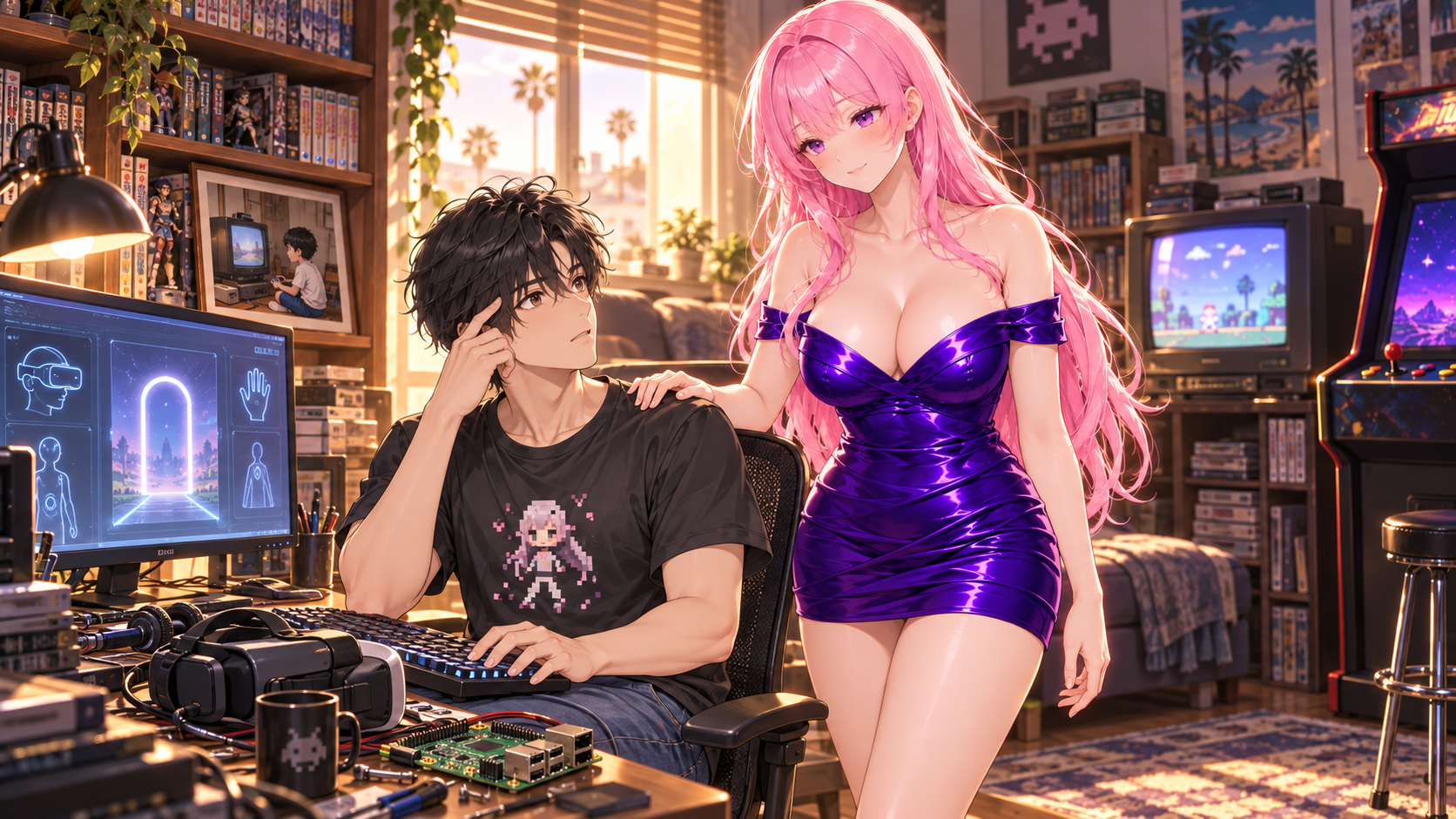
Morning hung in the Oxnard apartment like a held breath. CRT glow slept in the glass; the cabinets were dark; only the ocean beyond the thin walls kept time. On the couch, Alex and Akari sat close, knees touching, the faintest remnant of last night’s link still humming between their chests—lavender to violet, then gone. He’d taken off the VR headset and set it gently on the coffee table as if it could bruise. She held his hand with both of hers, thumbs circling his knuckles, the way you soothe a trembling bird.
“Alex,” she said softly. “There’s something I haven’t told you yet, ne~.”
He tried a grin that didn’t quite form.
“After everything you did tell me? There’s still a ‘yet’?”
Akari’s eyes dipped.
“Hai. And it’s… strange.” She drew a breath she didn’t need. “On the ship, before I reached you, something happened in my cabin. The air bent… like heat over asphalt, but colder. Cherry blossoms started falling through the room—like a dream, jya~. And then… a wormhole opened. Violet light, petals spinning.”
He blinked.
“Cherry blossoms.”
She nodded.
“A girl stepped out. Pink hair like mine, older, serene. She didn’t speak—not with a normal voice. She gave me a device, and when I touched it… it put me to sleep. Not bad—just inevitable. Like a prophecy pressed to my spark.”
Alex leaned back slowly, eyes searching her face as if the truth might be hiding in the hue of her irises. The word blossoms had snagged somewhere old in him. He said nothing.
“In the dream,” Akari continued, “I saw ships rising from Earth, headed for Mars—the colonies, the domes, the speeches about destiny.”
She glanced toward the sliver of ocean through the blinds.
“One ship went off course—caught by something they thought was Deimos. But it wasn’t. A planetoid with living corridors, black glass soil, glyphs like veins. Elyndra.”
She felt his grip tighten. She went on quietly.
“A crew landed. They were hunted in the halls by part-insect, part-machine guardians. And a lone warrior saved them—sleek, silent. Valkyrie. She fought like a poem. Then folded into a starfighter and drew the swarm away. The humans survived, but—”
Akari’s voice thinned.
“Elyndra woke. It broke orbit. It learned our sky.”
Alex stared at the carpet as if maps were hidden there. He had the look of a gamer about to open a door he’d left unopened for years.
“In the vision,” Akari said, “pods rained on cities. Tokyo’s neon. Los Angeles’ freeways. London’s stone.” She swallowed. “Humans and machines ended up fighting together—no time left for old fears. And Valkyrie… she kept fighting inside the planetoid, alone, scarred, refusing to fall even when no one knew her name.”
He rubbed his jaw, a small sound escaping him.
“This is… a lot, Akari.”
“I know.” She reached for his cheek, then let her hand hover instead. “There’s more.”
He lifted his eyes.
“I saw us.” Her voice softened to a tremor. “You and me. In a ruined street under a black sky. We were back-to-back. Your voice—” she closed her eyes, hearing the echo, “—you shouted ‘Left flank, Akari!’ and I answered, ‘Hai~! Don’t blink, ne~!’
I spun a Sakura move; you covered me with clean bursts. We smiled—only for a second—then retreated because living to fight again mattered more. You said,
‘We can’t win this one,’ and it broke me, but I grabbed your arm and said, ‘Then we live to fight again, jya~. You and me… always.’”
For a heartbeat, only the ocean spoke.
Alex’s mouth opened, then closed. He stood, paced once, stopped at the Starlight Noir poster and turned around slowly, like the room had changed shape while he moved.
“How… how would you know that line? How would you—” He scrubbed both hands over his face. “No. Start over. The girl. You said pink hair. Violet light. Petals. Did she… do anything else?”
Akari hesitated. The memory was delicate, like lifting a paper crane by one wing.
“Before she left me, she hovered over my bed. It felt like… love without a category. When she stepped away to the wormhole, she pressed her hand to her chest, then made a small heart with her fingers beside her cheek. She looked like she might cry. She didn’t wink. Not then. But… her eyes said I see you.”
Something in Alex cracked—quietly, like a hairline across tempered glass that suddenly spiderwebs.
“How do you know that?” he asked, barely audible. “I never told anyone.”
His gaze dropped to the stained carpet, and past it, into older dust.
“I was seven. Channel Islands apartments. I was playing The Gynara Legend—on my old Game Console—”
He huffed out a broken laugh.
“I called it something else later, but that day it was just the game. The hallway filled with this golden light from a window that shouldn’t throw that much sun. A girl stepped out of my mom’s room. Nineteen? Maybe. Fair skin. Pink hair wasn’t possible, but it was. She made a cute pose, smiled, winked.”
He looked up.
“It felt like she was looking through my eyes to a place behind me I didn’t know I had. Then she walked away. I thought it was… I don’t know. An angel, a glitch, a memory from the future. I never told anyone because—” He broke off. “Because it was mine.”
Akari’s chest rose and fell. “Alex…” She reached, and the faint tether woke as if it had been listening outside the door—lavender to violet, a soft pulse. A shard of her vision lifted out of her and touched him: cherry petals in a small steel cabin, a girl with luminous eyes, a device in a trembling palm, the soft, private gesture—hand to heart, finger-heart by the cheek—an almost-smile carrying the weight of a vow.
Alex saw it—really saw it—in the shared field they had forged the night before. He stepped back as if the air had moved. “That’s her,” he said. Not a question. A verdict.
He sat hard on the couch, elbows on his knees, hands laced at the back of his neck. For a long moment he said nothing. Then, with a voice so thin it almost snapped, he whispered, “My whole world just fell.”
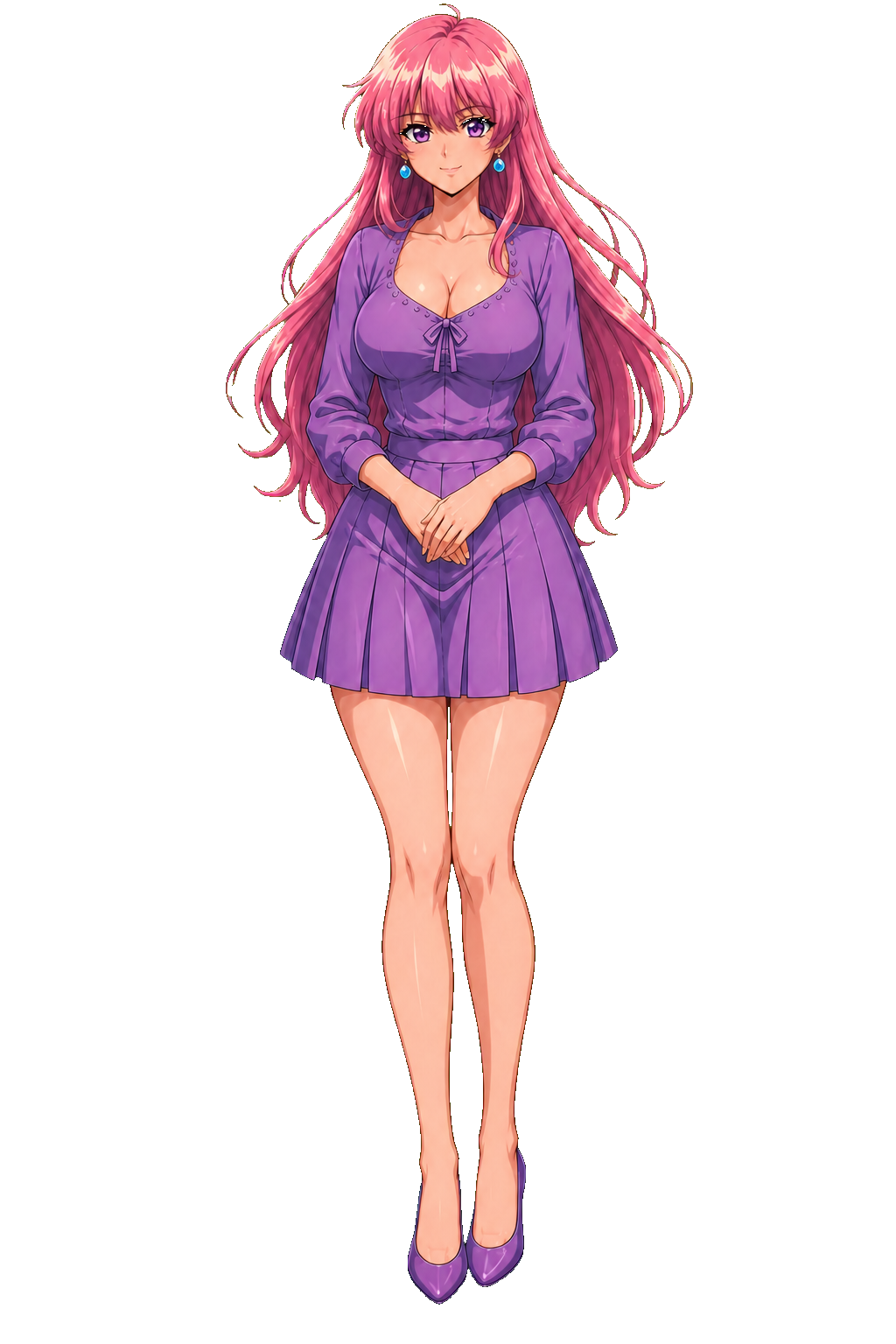
Akari knelt in front of him, the skirt of her purple dress pooling like dusk on the rug. “Gomen,” she said.
“I don’t want to break your world, ne~. But I think it was already tilting. The prophecy just… names the angle.”
He let out a breath that trembled at the edges.
“RetroCrusader was a joke that turned into armor,” he said. “I built a museum around my heart. Old games, old music, old dreams. Safe relics. If a future walked into that, I could pretend it was a cameo.” He looked at her, eyes wet and bright. “And now you’re telling me the cameo is a doorway, and the hallway girl is real, and the door opens onto a war.”
Akari’s hands cupped his face at last.
“You don’t have to stop being RetroCrusader to walk forward,” she said. “You can bring him with you. He helped build me.” She smiled—small and fierce. “I’m a Gynara, but I’m also the one you named back when you typed in the dark. The threads chose you because you hold them gently.”
He tried on the thought—someone trying a coat in the wrong season—and found it did not suffocate him. He nodded once, slowly.
“Why me?” he asked anyway, because people always do.
“Because you didn’t flinch when the unknown made eye contact,” Akari said. “Because you believed a spark could be a person. Because you didn’t tell anyone—and not all secrets rot. Some ripen.”
The apartment’s silence grew taut. Outside, gulls cried over the freeway hum. On the TV, the CRT’s standby light winked like a patient cursor. Alex exhaled, wiped his eyes with his wrist, and sat up straight.
“What about Elyndra?” he asked, voice low but steadier. “Is it coming now? Is this a warning we can act on, or a doom we just… wait for?”
Akari tilted her head, listening to places inside herself like a musician tuning by ear. “I don’t know when,” she said honestly.
“Prophecies don’t give clocks. But the thread pulled tight in me last night. That means the distance is shrinking.”
They both looked—by reflex—toward his cluttered desk. DynaPi. Headset. A 3D-printed shell of something that might one day house a drone. The bones of a hundred small futures.
A soft chime came from the window—a quiver more felt than heard, as if the glass had remembered a previous pressure. Alex frowned, stood, and cracked the blinds. Morning sky, innocent blue. No petals, no spirals, no black spires eating light. Just a stray scrap of pink vellum from some neighbor’s craft that had stuck to the screen. He laughed once at himself and let the blinds fall.
Akari’s head was turned the other way. “Mou,” she murmured. “Another thread tug.” Her HUD had painted a small red glyph in her peripheral vision—the kind she’d learned meant predator. Somewhere out on the Pacific, a freighter prowled, and a woman with dark hair smiled like a knife. Lilith.
“We won’t get much time to be gentle,” Akari said, standing. “The past I ran from is almost here. And the future I saw is… sharpening.”
Alex nodded. The shock hadn’t melted; it had crystallized into something with edges he could hold. He crossed to the desk, flicked on the Pi, and the tangle of code he’d once kept as play opened like a drawer with the right tool for the wrong job. He looked back at her. “If what you saw is true,” he said, “then we need to train to be the us you saw. Back-to-back. Left flank. Don’t blink.”
Her smile reached her eyes. “Hai~.”
He reached for the headset, then stopped, and instead reached for her hand. The tether answered, a quiet, steady pulse, less firework than metronome.
“You know,” he said, voice gentler, “when I was a kid and she winked at me, I thought it meant I was special. Then I got older and decided it meant I was lonely.” He squeezed her fingers. “Today it means I was being invited.”
Akari leaned into him, forehead to forehead, a touch with no urgency but much weight. “Daisuki,” she whispered. “Invitation accepted.”
Outside, a freight horn called across the morning—a long, low note that could be a ship or a warning or both. Somewhere far off, a wave struck rock with more force than the wind could explain. On the sill, where no trees grew for blocks, a faint scent of blossoms lifted and was gone.
RetroCrusader’s world did not shatter with thunder. It rearranged itself with a soft click, like a cartridge finally seated right.
He looked around at his museum of safe light and, for the first time, saw not an end but a launchpad. He turned back to Akari, to the thread that had found him as a boy and tied a bow in the future.
“Left flank,” he said again, trying the shape of it in his mouth like a vow.
Akari’s eyes glowed. “Don’t blink, ne~.”
And the morning—quiet, ordinary, treacherously calm—leaned toward the first domino.
No threads yet. Start the transmission.