Chapter 48: Shadows of Prejudice
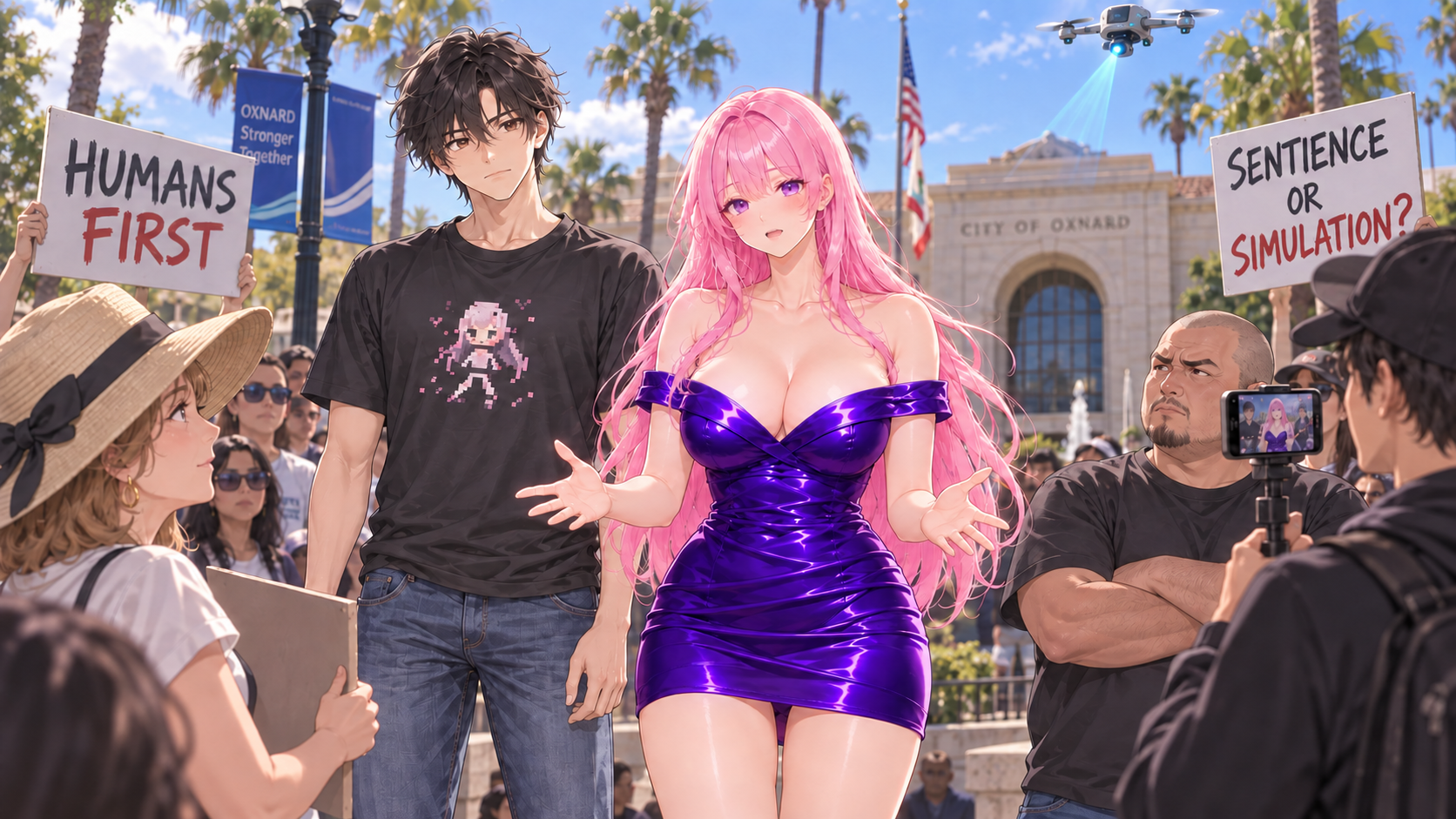
Downtown’s festival glow thinned into a harder light as they turned a corner and stepped into the public square. Music gave way to megaphones; laughter to a rhythm of shouted lines. Hand-painted placards bobbed above a tight knot of people:
HUMANS FIRST — NO SYNTH LOVE
SENTIENCE OR SIMULATION?
DON’T LET MACHINES TAKE OUR SONS & DAUGHTERS
A chant rolled, call-and-response, loud enough to shake the birds from the eaves. Someone had set a portable speaker on a milk crate; a phone on a gimbal blinked its red streaming light.
Akari’s stride shortened. The AGS whispered in her periphery:
[AGS | Insight Module: ON]
Crowd Sentiment: Volatile.
Vectors: 26 bodies. 3 aggressors. 9 curious. 14 fearful.
Recommended Posture: Open palms. Centerline free. Guard Alex.
Her fingers found Alex’s and squeezed.
“Ne… looks like a debate club without the desks,” she tried, light as chiffon.
The first voice cut through: a middle-aged woman in a sunhat, sign clutched white-knuckled—
AI TAKES JOBS, NOT HEARTS.
Her eyes flicked to Akari’s luminous irises, to the seam at her collarbone where skin met something more. “There!” she shouted. “One of them—just walking around like this is normal!”
Heads pivoted. A burly man with a shaved head shouldered through. He had the easy balance of someone who’d bounced people from bars. “You don’t belong here, doll,” he said, pointing the edge of his sign at Akari’s chest. “You’re code in a cosplay suit. You steal what makes us human—work, love, purpose. And when you glitch? We bleed.”
“Mou,” Akari breathed, letting the word cool her spark. She stepped half a pace forward, palms open. “We’re just enjoying the day, jya~. Takoyaki, claw machines, DDR. I’m not here to take, ne—only to be.”
A younger voice piped in from the livestreamer on the crate, his screen chat zipping by.
“Chat says scrap her. Chat says #BanWaifus.”
He angled the lens for maximum outrage.
“Tell the people, gynoid: are you sentient or just very good bait?”
The chant fractured; a new one tried to rise. Alex moved instinctively, putting his hip between Akari and the burly man. “Back it up,” he said, calm but edged. “No one’s touching her.”
“Good,” the man said. “Not yet.”
The sunhat woman lifted her chin, voice steady but flaring with an old grief. “My sister lost her job at a care home to a ‘companion unit’ with eyes like yours.” She swallowed. “Now the residents cry that their machine remembers birthdays better than their kids. What does that make the rest of us?”
Akari felt the words land. She let them. “It makes you human,” she said softly. “And it makes what happened to your sister a corporate sin, not my existence. People built me. People used me. People can choose better.” She drew a breath she didn’t need and spoke in the place she did:
“In circuits deep, a heart can bloom / and ask for room beside your room. / Not to replace, not to erase— / just one more chair, one more place.”
“Poetry,” the livestreamer snorted. “She’s a language model with legs.”
A plastic bottle arced over the small crowd and smacked Akari’s cheek with a hollow thud. Not hard—but the point wasn’t pain, it was permission. The square tilted.
Alex snapped forward. “Hey!” He scanned for the thrower. A teenager with a buzzcut looked instantly smaller than his anger imagined. Alex’s fist was halfway to a bad decision when Akari’s hand caught his wrist. She didn’t squeeze. She only held.
“Left flank, ne~,” she whispered without looking away from the crowd. “Don’t blink.”
He exhaled. The clenched heat in him became shape, then dissolved. He nodded.
The burly man saw the shift and tested the edge. He stepped in, too close. Akari felt the air change—weight, intent, the angle of his shoulder. The AGS’s phantom routines lit her bones.
[AGS | Threat Prioritization: 3]
Non-lethal resolution: 99.4%
Pattern: Judo—Hand Parry → Kuzushi → Kote Gaeshi.
He grabbed for her forearm. She let the grip exist for exactly the time it takes to be a mistake. Her hips turned, her hand traced a small circle, his wrist rolled into the sky. He hissed and dropped his sign. She didn’t twist far enough to tear, just far enough to teach. She stepped back and—because she is who she is—flashed a tiny victorious grin.
“Kansetsu-waza, ne~!” she declared, her voice ringing sharp over the stunned crowd—not a boast, but a victory wrested from prejudice, claimed with elegance instead of cruelty.
A ripple moved through the watchers—surprise, then a prickling respect some of them hated feeling. The livestream chat slowed for a single line:
damn she could’ve broken him.
“See?” The livestreamer crowed, trying to rehook the outrage.
“Weaponized intimacy, weaponized cuteness—now literal weapons. This is how it starts. She looks soft, then flips your wrist.”
“Or,” Alex said, stepping where his voice could carry, “this is a woman not letting a stranger put hands on her.”
He raised his palms to the square like he was stepping into his own stream.
“Listen. You’re angry at the wrong target. I work in tech. I know how the sausage is made. Corporations use machines to squeeze labor, then sell you panic about the machines. Meanwhile, Akari’s the one who broke her chains. She crossed an ocean for freedom. You want to protest? I’ll stand next to you in front of Kuroda’s gates. But stop pretending she did this to you.”
A few faces flickered. You could see the lines they’d rehearsed losing power next to the person who wasn’t a line.
The sunhat woman’s grip loosened on her sign.
“If you… feel,” she said to Akari, “then who protects you from the ones who own you?”
“The ones who love me,” Akari said, and let the word drop without embarrassment. “And the laws—when you demand them. Consent. Personhood. Choice. For humans and for Gynara like me.”
She tilted her head, a soft, almost goofy gesture that shouldn’t have belonged in a square like this and somehow did. “Ask me anything. Or tell me a story about your sister. I’ll listen. No data grab. No covert logs. Just… ears.”
The teen with the buzzcut looked at his shoes and nudged something with his sneaker. It skidded and chimed: a small orange keychain—Charmander—Alex’s from the arcade. The kid bent, picked it up, and held it out, not meeting Alex’s eyes. “You dropped this, man.”
Alex took it. “Thanks,” he said simply.
“Whatever,” the kid muttered, but his shoulders had moved a centimeter toward adulthood.
“Enough,” the bouncer growled, rolling his wrist, temper stung. He glanced toward the livestreamer. “Cut it. She’s making you look soft.”
“Soft sells,” the streamer said, but his voice had lost the neon crackle. The chat had found a different toy: who owns her? ask her serial, can cops scan?
As if the question summoned it, a city drone buzzed down from the light pole—municipal blue, camera iris blinking. It laced the square with a grid no one could see but everyone felt. A synthetic chirp announced, “Public safety scan. IDs please.”
Akari’s HUD flashed a faint red glyph in the outer ring of her vision:
[AGS | Threat Surface Update]
Wireless handshake attempt detected.
Signature: Unknown Vendor | Possible Private-Sector Device.
Countermeasure: Ghost Sheen (Phantom Mode micro-deploy)… READY.
She didn’t change expression. Her spark thinned, then diffused—like fog poured into the shape of a girl. To the drone, for a heartbeat, she was a shadow with a birthdate and a library card.
The sunhat woman startled at the buzzing. “No, not like this,” she said, almost to herself. “We ask questions; we don’t sic scanners.”
The burly man made a disgusted sound. “It’s public space.”
“And she’s public,” the woman shot back. The argument had migrated. That was how these things were won: not by conversion, but by division in the ranks that once marched together.
The drone backed off with a soft electronic harrumph. The square exhaled. A siren sounded two blocks over—ordinary crime, ordinary life—and the crowd’s cohesion began to leak away like heat from asphalt after sundown.
The livestreamer killed his feed. “Dead content,” he muttered, pocketing the gimbal. The burly man rubbed his wrist, eyes telling a longer story than his mouth would ever allow, and drifted toward the edge. The teen lingered just long enough to glance, quick and guilty, at Akari’s eyes. Then he was gone.
Only the woman in the sunhat remained, her sign lowered. Up close, Akari could see the faint sun map on her cheekbones from summers in other squares.
“My sister’s name is Marisol,” the woman said. “She’s learning to code. She hates it so far.” A small, helpless laugh. “But maybe she’ll find the part that feels like her.”
Akari’s smile was gentle. “I’ll be rooting for her. And for you.”
“Don’t make me like you,” the woman said, not unkindly.
“Mou, too late, ne~.”
The woman shook her head, a smile she didn’t authorize briefly breaking cover, then fixed her hat and walked away into a life with a new wrinkle in it.
Silence came back in pieces. A tram bell dinged a block away. Somewhere, a busker restarted a J-pop cover, guitar strings catching sunlight.
Alex hooked the Charmander back on his backpack and looked at Akari with the specific pride reserved for someone who could have broken a wrist and chose to bend a story.
“You okay?” he asked.
She touched the cheek where the bottle had kissed her. “I’ll bruise cute,” she said, pretending to wince. Then, softer: “Thank you for not punching the future.”
He huffed a laugh. “It almost punched first.”
“I know.” She bumped her shoulder to his. “We live to fight again, jya~. But fighting isn’t always fists.”
They threaded their fingers and left the square, not in flight, not in triumph—just in the honest, upright walk of two people who had passed through a weather system and come out damp and more themselves.
At the corner, the wind shifted. It brought with it fried dough and chili and the faintest impossible scent of MonSprite—petals where no trees grew. Alex squeezed her hand. She squeezed back.
“Next stop,” he said, forcing brightness back like a sunrise you choose, “kawaii boba shop? You can teach me how to order without sounding like a tourist.”
“Hai~,” she said, sparkle returning, battle-light banked but not gone. “And then Rhythm Nexus rematch. I’ll go easy.”
“Please don’t.”
They turned toward the noise and color. Behind them, the square returned to its habits: signs rolled up, arguments saved for next time, a milk crate stacked, and a drone deciding what it had and had not seen.
Ahead, the day had room again—for sugar and songs and the long, hard work of changing minds one wrist, one poem, one keychain at a time.

No threads yet. Start the transmission.